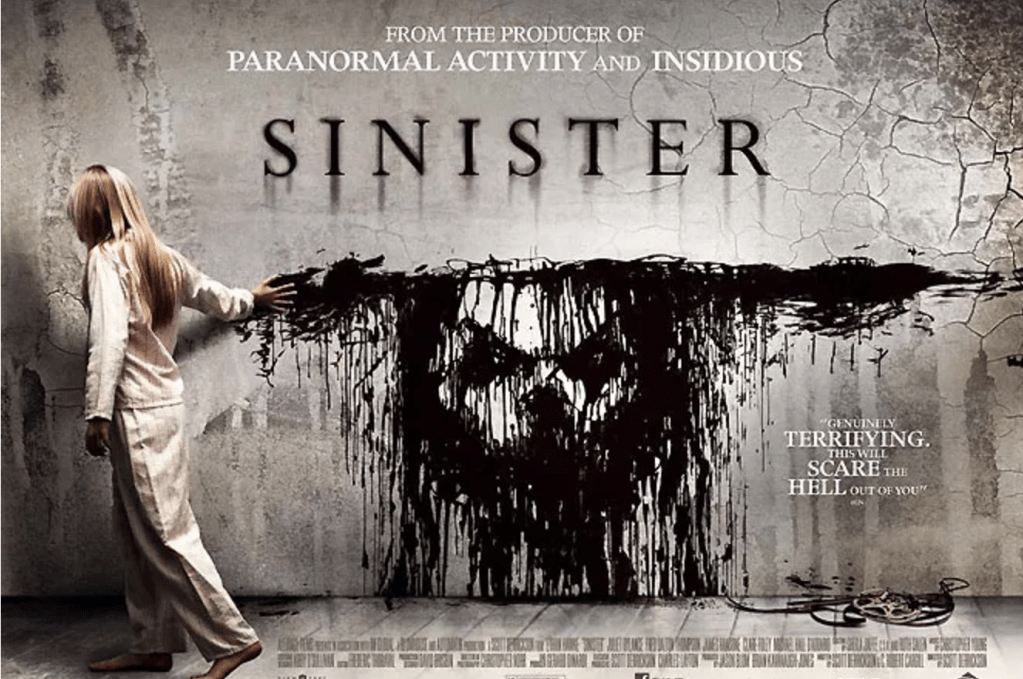
The 2012 film Sinister has always stuck out to me as the best horror movie experience I have ever had, and I attribute the influence it had to the music. I think the visuals of the home videos we watch being on 8mm film is also an artistic element that makes the film dream-like, dark, and unexpected. But the coherence of the film along with the use of the soundtrack and particular choice of music brings an experience that propels the whole movie into another realm of terror.
The use of music, especially in horror, is vital to its experience. Horror, historically, is composed mostly of silences, and loud jump scares. In order to lure you into the story so it doesn’t become only about the silence and gory crunches and sound design, you need to have strong musical accompaniment that enhances the value of the storytelling and curates the mood of the film. What do we remember most about the classic horror films? The themes- think Jaws, Halloween, The Exorcist. And they work because they are unnerving, but how do you make music scary? What are the elements to look for? Let’s explore what Sinister chose to latch on to.
The first outstanding song choice was Gyroscope, by Boards of Canada. This plays at the beginning of the movie when the main character, Ellison, is deep diving into the mystery of the family murder in the house he just moved into. This song kicks off the whole movie and is when things really start to get creepy. I remember first listening to this and just getting chills: he’s knocking boxes off tables, setting up the film projector. And suddenly the viewer is thrown into a sloshing, rabid sea of close-up shots and quick cuts of his actions while this rolling, momentous drum-focused song is playing in the background. It changed the whole experience. Not to mention the off beat, fuzzy audio of a child counting in the background. It all feels so eerie and disconnected. This is when we dive into the mystery with Ellison, and immediately we are lassoed in; we are hooked.
The next portion of music is from Ulver, a Norwegian, experimental electronica band. The song is called Silence Teaches You How to Sing, from an album released in 2004. This song is played while the 8 mm films are being watched. This was a conscious decision made by director Scott Dickinson, who wanted a separate soundtrack for when the films were playing, which was unrelated to Christopher Young’s own genius soundtrack which plays throughout the rest of the film. Dickinson researched and explored various experimental bands and their music to find the right one to create the atmosphere for the nightmarish portion of the film when the films were displayed.
The other songs used while the eerie 8mm films are playing are Sacrifice, by Aghast, A Body of Water by Judgehydrogen, and Frgament 9 by Accurst. The first uses heavy and dark resonating tones that sound like the darkness of a wave, with eerie chanting in the background, faded and distant enough that you can’t make out the language or the words, but loud enough you can hear the intensity and deepness which translates into a chilling darkness. Judgehydrogen is composed of eerie, whispered, repetitive lyrics on top of a ghostly echoing deep, depraved and hopeless moan. Fragment 9 is the song used in the infamous lawnmower scene, and it sounds like the unsettling and repetitive build up to something unpleasant. We can picture this unpleasant buildup in our head as we listen, if you’ve seen the movie, without even needing to revisit the film. There’s eerie undertones of snarling amidst this repetition, and you can’t help but feel a sense of dread, and confusion, when you listen.
Trying to pinpoint in words what makes this music so unnerving is difficult, but only because I wonder if it would’ve felt so unnerving without the visuals that I experienced it with. It feels chaotic, and dissonant, almost dream or nightmare-like with its static, vintage crackles and warped echoes and tones. A portion of Ulver’s 23 minute song is also reminiscent of, and certainly inspired by, the piano music in David Lynch’s Twin Peaks. The element of the song being so long and having so many disconnected elements and parts also gave the Director the opportunity to cut and use certain sequences. Each portion has a flavor, and air, of its own characteristic warped distortion. It is impossible to hear these songs now without seeing the visions of the 8mm films in my head, each one, vividly.
The dissonance, the chaos, the distortion, the echoes of heavy, melancholy melodies, the clinking and static sounds reminiscent of vintage film and gramophones, it all makes for such a unique and unnerving base to throw on an already well done horror film. But I think really is the core element that makes this movie what it is; the choice of music which saturates your core and directs the experience you have to the visuals emotionally, and physically. Why are vintage sounds so terrifying? Why can religious chanting, also, be so tremendously unsettling? Is it what we associate it with; old things, decay, creepy and abandoned houses, films that have utilized this old audio trope before? Either way, the songs chosen for the 8mm scenes of the film are absolutely perfect. A picture of horror, chaos and dissonance, I’m adding these to my spooky playlist.
Music used in the film:
Sacrifice – Aghast
Accurst – Fragment 9
Gyroscope – Boards of Canada
Blood swamp- sun 0)))
A body of water- Judgehydrogen
Ulver – Silence Teaches You How To Sing
Call from the grave – Aghast
Resources:
http://kinsta.blogspot.com/2013/02/the-music-of-sinister.html#:~:text=Sure%2C%20there%20ar e%20a%20couple,really%20gets%20under%20your%20skin.
 SydneyLaura.com