180 The Strand, London, UK, 2021
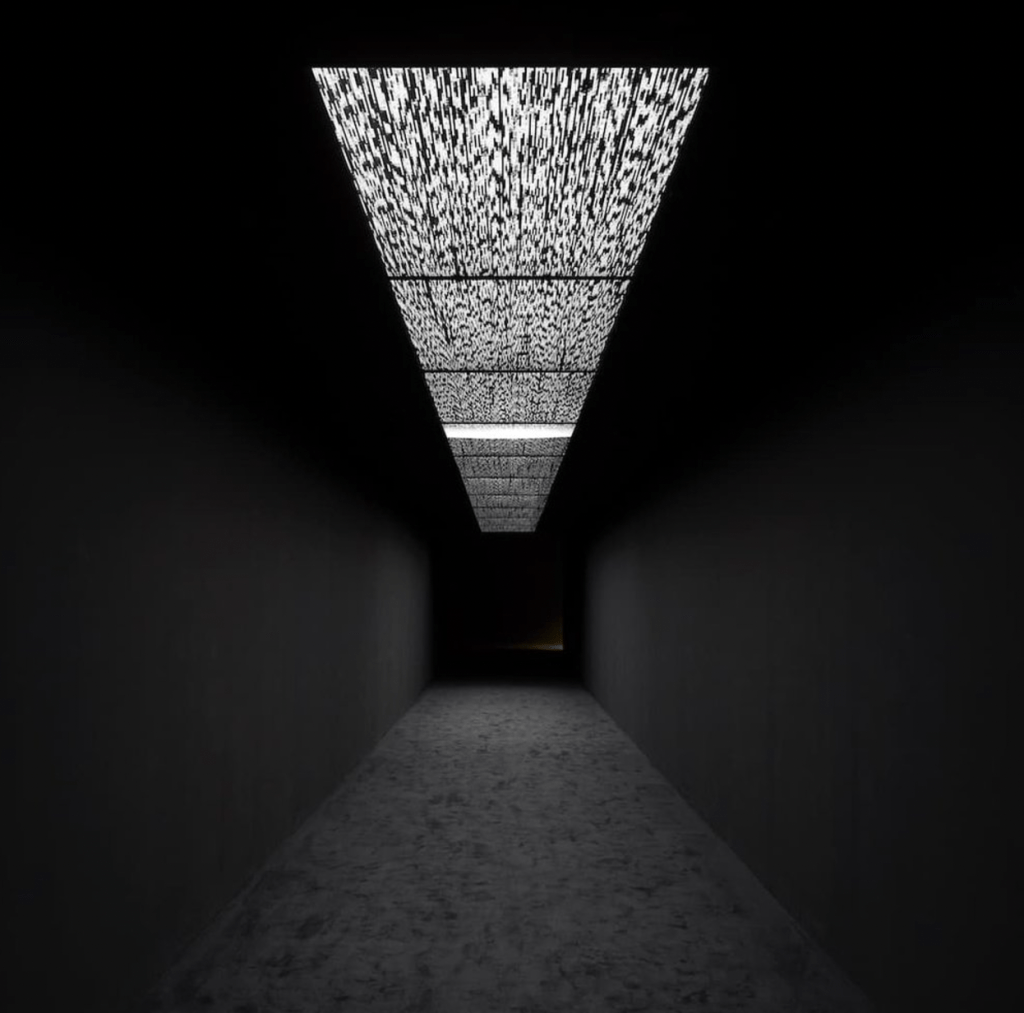
Subterranean, cinematic, existential sensory overload would be a few ways to describe this cultivated maze of light and noise by Ryoji Ikeda. If you are used to strolling through quiet galleries with hands clasped behind your back contemplating the day’s future activities, this will be a jolting change of pace. Ikeda leaves no room for ponderous thoughts to manifest while one inhabits his exhibit. It feels almost like a Universal ride, or as if you are being swallowed by a loud mechanical creature. It is an experience so viscerally invasive, you cannot help but be 100 per cent immersed.
Your first introduction to the space as you walk in is a large room filled with cubes rising up from the floor with screens over the top displaying what seem like frantic, extensive data of some sort. To move on from this room you must pass through a corridor made entirely of nearly blinding LED light. There’s a deep sense of anxiety as you pass through, wondering if you can or should keep your eyes open. The extremity of the experience is disorienting, as it is with each coming room.
In the following room you are assaulted with noises that progress and change in a high pitch as you walk around a room lined with giant SB-I speakers turned to the note of A which ‘modulate and undulate in a semi-abrasive soundtrack unique for each visitor’ (Smith p.5). If you are brave enough to endure the disorientation, instead of standing safely between speakers, you wander around an ocean of sound waves pulsating and growing and changing around you, almost off setting your balance. It is easy to feel like a bug in a jar, or part of a cruel or torturous experiment.
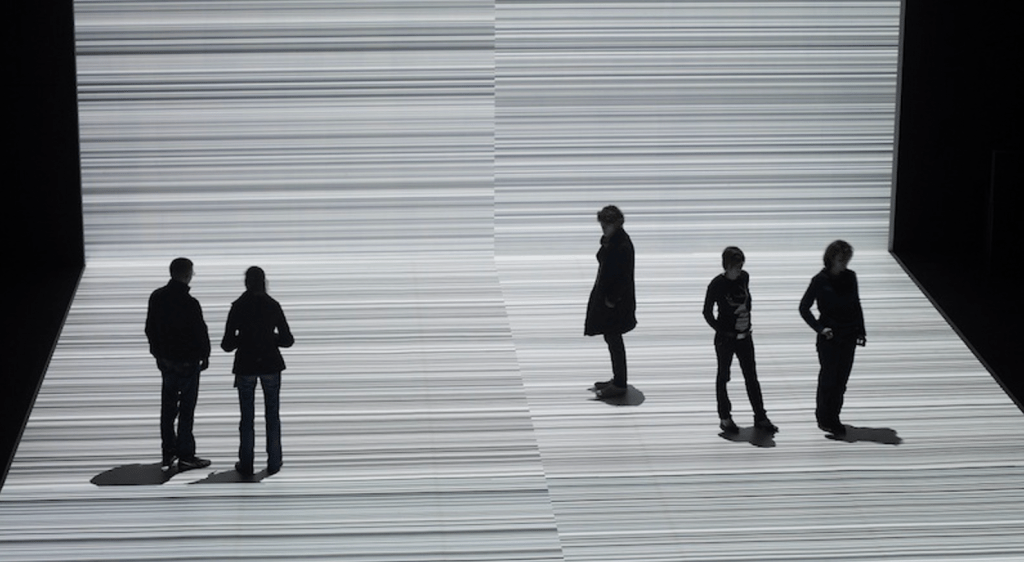
Next up in this funhouse of an exhibition is a large pulsating void on a screen, the point of no return. In a large, empty, black warehouse room is a screen of a black and white void, pulsating so rapidly you can see colors in between the lines, a strange optical illusion you can hardly tear your eyes away from. Of course for an experience in Ikeda’s art, it could not be without sound, a deep, empty hum, that sounds like the concept of void if you could ever imagine it; deep, immense, echoing, eternal.
The creator says about this portion, it is a very simple, very intense piece, “I paint a black circle on a wall and project light around it, and this intensifies its blackness. It feels like it’s always firing, you get a bit scared. It becomes overwhelming.’1 An active, creating, void, something proverbially empty and lacking, simultaneously firing and taking up space.
The second to last room is a set of three screens where a rapid display of images flash before you on all three screens of brain scans, graphs, coordinates, webs, maps and molecules. It feels cold and calculating, reducing everything in existence to information. Much like entering a black hole, everything we know in the macrocosm, and the microcosm, is reduced to information and calculations. In one room, reducing all of history, mankind, space in its entirety, and everything we have ever known, into something nearly nonexistent with just the rapid progression of images. This is the void continued; it is all a black hole of all that is and has been, swallowed up and reduced to nothing at all in a matter of seconds.
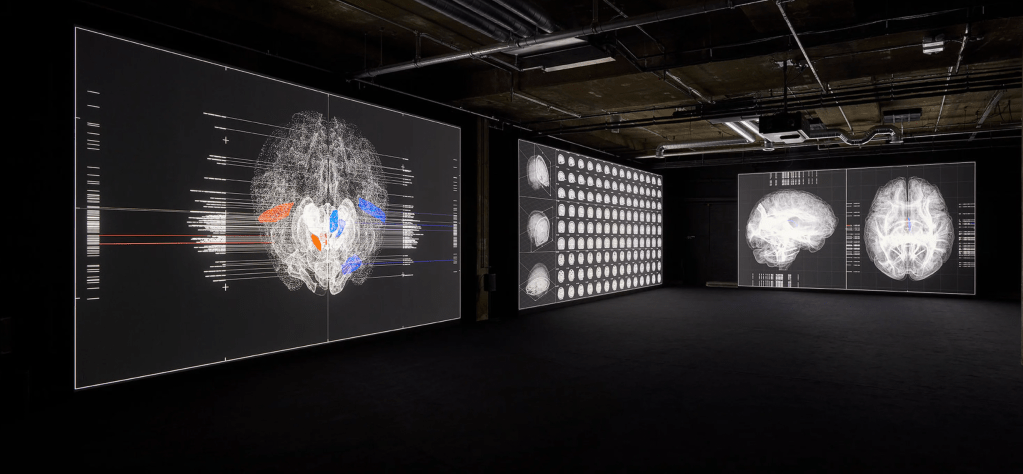
As these images flash before us of the microcosm and macrocosm, we see similarities between information and data and the human brain and functions. The human genome, DNA codes, brain scans, maps of galaxies, all the information that shapes our existence, cycling right back through to each other like a giant display of the representation of the golden ratio.
To some, it may have felt like walking through hell, this whole exhibition, to others, it may have felt like looking at the Creator of everything; staring right into the void and everything it’s ever created, and swallowed up again by the opposite of everything; the existence of nothing at all, and then coming right back out into the world again. It feels like the traumatic process of birth and death in its assault on the senses and undeniable existentialism of it all.
- Lloyd-Smith, H. (2021, May 20). Review: Ryoji Ikeda’s London show is a sensory assault course. wallpaper.com. https://www.wallpaper.com/art/ryoji-ikeda-180-the-strand-exhibition-review
↩︎
 SydneyLaura.com