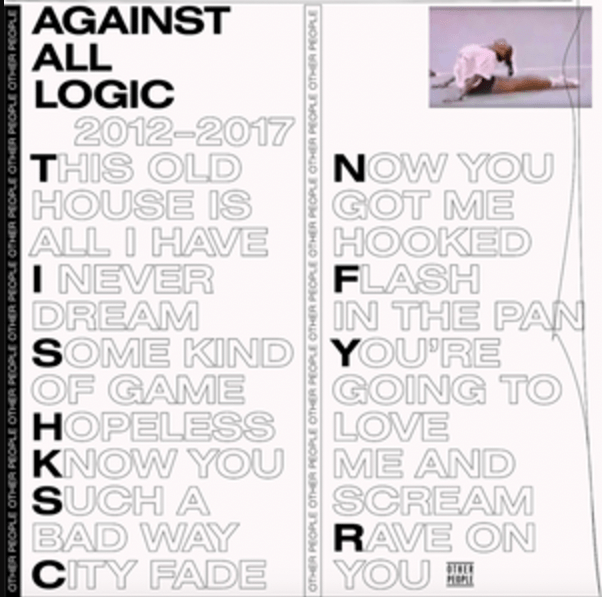
A master of mixing and sampling, Nicholas Jaar spent 5 years working on this electronic, sample heavy chef d’oeuvre that he released under the alias Against All Logic, with nearly no introduction or announcement before its drop. For most of his career, sampling has been the foundations of his sound, and he manages to structure his samples in ways that don’t exhaust them or dilute them, building cathedrals out of fragmented layers of sound. Remarkably textured, with blurts and crackles of noise, like the end of ‘You Are Going to Love Me and Scream’ (nice and crunchy), this album is an homage to wonderful sequencing as well as production. With moments of exuberant fervor, as well as more somber and brooding moments, Jaar maintains the BPM so as not to stall the flow of the record as a whole. Marrying a combination of stirring vocal refrains and transcendent melodies, as well as cacophonous and frenetic noises, this corpus of work is a tribute to beautiful sound design.
Jaar opens the door to this album with ‘This Old House is All I Have’, the distorted bass rumbling like electronic thunder in a gloomy foreboding sky, or like airstrikes in a war. Sampled from ‘the warnings part II’ by David Axelrod, the lyrics ‘the foundations of the world are being broken’ introduces us to the album with distortion that sounds like the beginning of a storm and then opens up into a more groovy guitar riff with occasional heavy entities of distortion and static.
‘I never dream’ is my personal favorite song on the album and a strong contender for best song of all time. I listened to this for the first time in a van going on an art history course trip with some uni friends through the tuscan countryside. With the window down and the hot wind blowing through my hair, I blasted this song on repeat with the intention of initiating a Proustian-Madeleine affect for myself in order to preserve it in all of its ethereal perfection. The ascension in the middle of the song builds into a dreamy soundscape of catchy samples, hi hats, kicks and snare drums assembled in perfect predictability; nothing is overwhelming or overwhelmed.
‘Some Kind of Game’ is more galloping in its tempo and open in its expanse, a classic house and dance track also integrating elements of funk. Building and excitable, it opens up new directions for classic techno and deep disco house sounds. Sampling from ‘After the Rain’ by Pastor T.L. Barrett, he captures the joyful ending of this melody and uses it as a foundation for the beginning of his song and builds a modern resuscitating deep house beat to it. The solo stick rhythm towards the end of the album is the grooviest bit.
‘Hopeless’ is a more Aphex Twin reminiscent deep house tune composed of an assortment of clanging sounds that conjure up images of an arcade with ski balls or billiard balls bouncing around. The tempo tries to keep up a 4 x 4 beat but hiccups and stutters and flounders all over the place, keeping you engaged in the repetition of the beat. The essence of ‘Hopeless’ sounds like waiting, or impatience, or the ticking of a clock.
Sampling from ‘Ain’t No’ by Jorge Santana, ‘Know You’ returns the sound back to funk with this sped up sample, a relief after the anticipatory buildup of the previous track. Seamlessly integrated, like all the samples on this album, you can’t tell where the sample ends and Nicolas Jaar’s contributions begin. One of the more ebruillant, hopeful songs on the album, it seems to swing you about and launch you into space.
‘Such a Bad Way’ is again one of my favorite tracks on the album, opening with an eerie, sort of melancholy tune, but building into something happier and brighter as it explodes at the bridge with a screaming sample from Kanye that somehow doesn’t feel out of place. Mellow and rolling, with a steady tempo keeping the beat similar to ‘some kind of game’, one of the most joyful and uplifting tracks on the album. The bubbly, bouncy, playful rhythm eventually withdraws into a more contemplative, relaxed joy by the end of the song. If you only listen to one song on the album, let it be this one.
Using the children of Gospel choirs, Nicolas Jaar creates in ‘Cityfade’ a daunting, anticipatory, low to the ground tempo that exhausts itself into something racing and mechanic. Sampling and splicing the sound of an ambulance that sings as it approaches from afar and flies past and is cut off, you get the sense that you are being taken somewhere urgent, and then trumpets build the song intensively into a climax. A blur of images and flashing lights whirring by in the aftermath. A fucking groove.
Ben Niesen makes a good statement about Nicolas Jaar and his influences in modern music “The internet has taught millennials two things: one that life is a DJ set, a photo-album of moments, and two, the treasures are out there- you just have to go out and find them.” Utilizing musics great power to create experiences, but also to record them, samples pay tribute to previous great (or forgotten) musicians by recycling their sounds into something new, and orchestrating a collage of experience in sound form. Jaar’s sense of pacing in each individual song, and the record as a whole, dismissing the records self proclaimed ‘throwaway’ piecing together of various tracks over a period of years. With a respect for his own tempo and choices, Jaar approaches this album with a sense of reckless abandon towards the dogma of genre, molding his samples into obscure shapes and coherent experiences. As one reddit user has so adequately stated, ‘This album slaps the bucket, tosses the salad, strains the juice, etc.’
 SydneyLaura.com